<No_HOOK_JETLAG>
Jeremy Palluce.
2025.11.22 - 2025.12.05
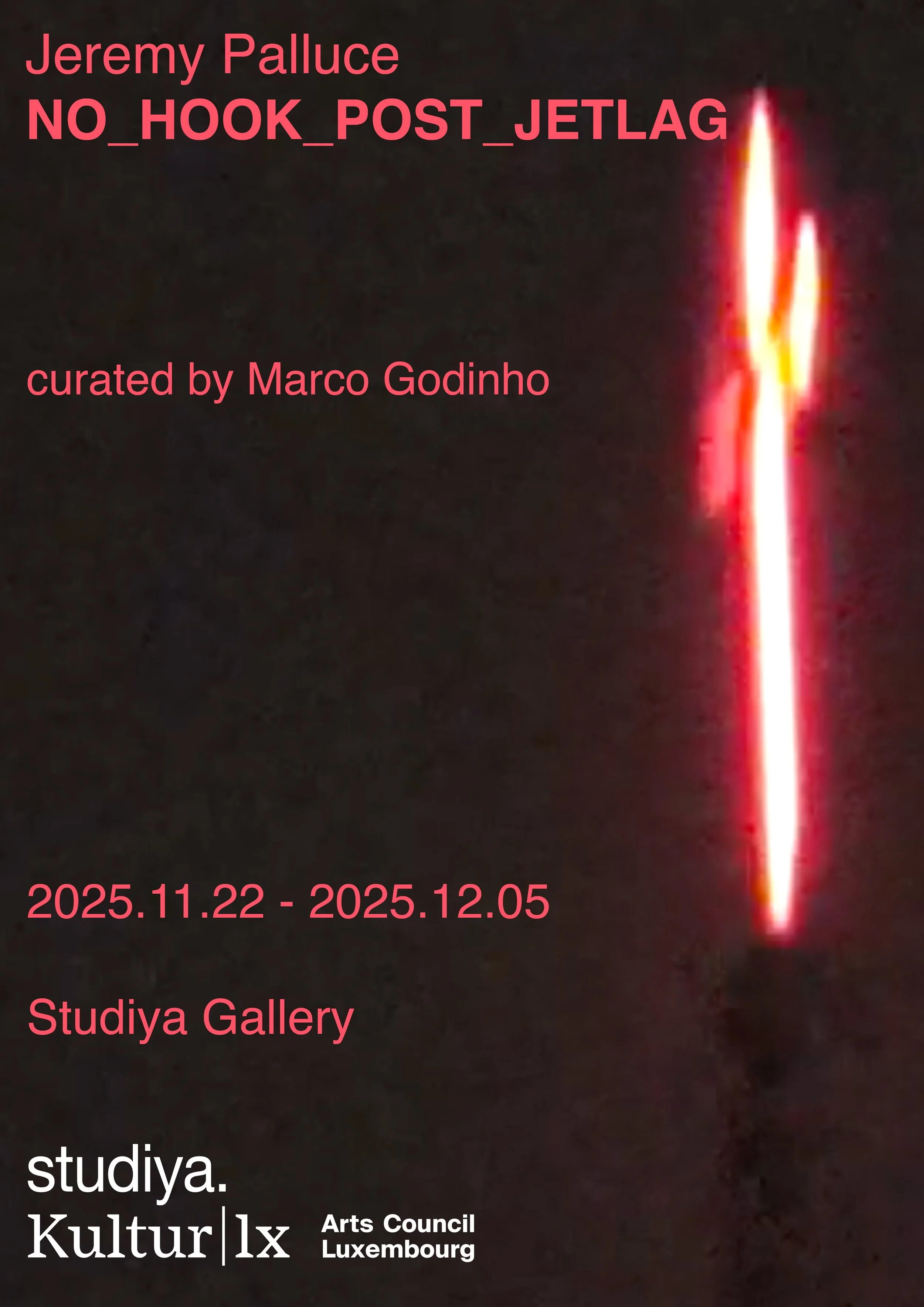
Jeremy Palluce, a Luxembourgish artist, returns to Korea—after a first project in 2023 in Busan with his friend, Korean artist Sijin Jung—for a residency at Studiya, an international art collective and artist-run space based in Seoul. He presents NO_HOOK_POST_JETLAG, an exhibition that extends his research and questions cultural, social, and popular codes.
“NO HOOK,” a title borrowed from a song by La Fève — a French rapper of Kino-Congolese and Cameroonian origin who embodies the “new wave” of French rap through the diversity of his influences and his innovative approach — serves here as a starting point. In the musical context, particularly in rap and hip-hop, a “hook” refers to the repetitive, catchy part of a track, usually the chorus, designed to catch the listener’s ear and remain in memory. “No Hook” literally means “no chorus” — an approach in which the track is built without this traditional repetitive structure. It breaks away from the commercial conventions of pop and rap music, favoring continuous flow, uninterrupted narration, or freer explorations of form. It is an artistic gesture that rejects the easy, predictable hook in favor of something rawer, more direct, and more authentic.
By integrating underscores into the title, Palluce continues the exploration he began earlier this year with _FINAL_FINAL, in his exhibition at Konschthal Esch (Luxembourg), which already evoked the impossibility of a definitive, fixed version in a digital world where every form seems forever subject to new revisions. With POST_JETLAG — what I would describe as an awakened sleep — the artist once again invites us to question our codes, whether religious, urban, or otherwise, and to plunge, not without humor, into a world in perpetual transformation.
One of the first — and one of the only — elements Jeremy brought directly from Luxembourg on his computer are the ad-libs from the latest album by his friend and colleague, Luxembourgish rapper Brooze. In a careerist and contextual approach, this latest album focuses on the German language, which is also audible in these fragments that overlap with those of a Korean rapper Yonge Jaundice, whom Jeremy also asked to send ad-libs from his recent songs. In this latter case, English is the language the Korean rapper champions to break into the scene. Brought together in the same space, face to face like a duel or a battle, the two universes intersect and respond to each other at the center of the room, where a minimal object placed on the floor echoes the pedestals of another work in the first room. The object lies there, waiting in the projection of light, ready to receive the moving bodies of the visitors, who—through their movement—activate an essential belief: that of believing in the creation of musical language, as though it were a religion.
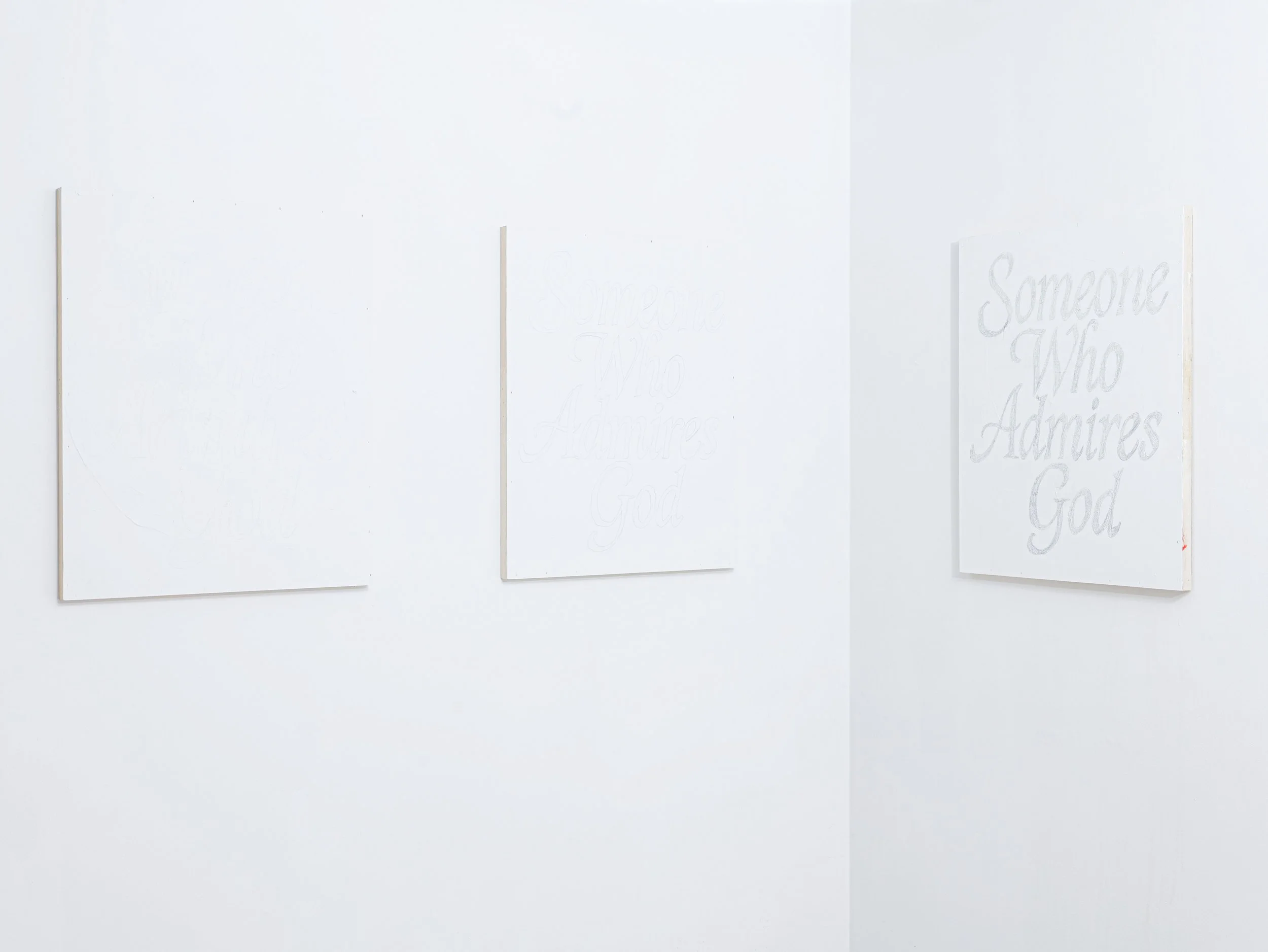
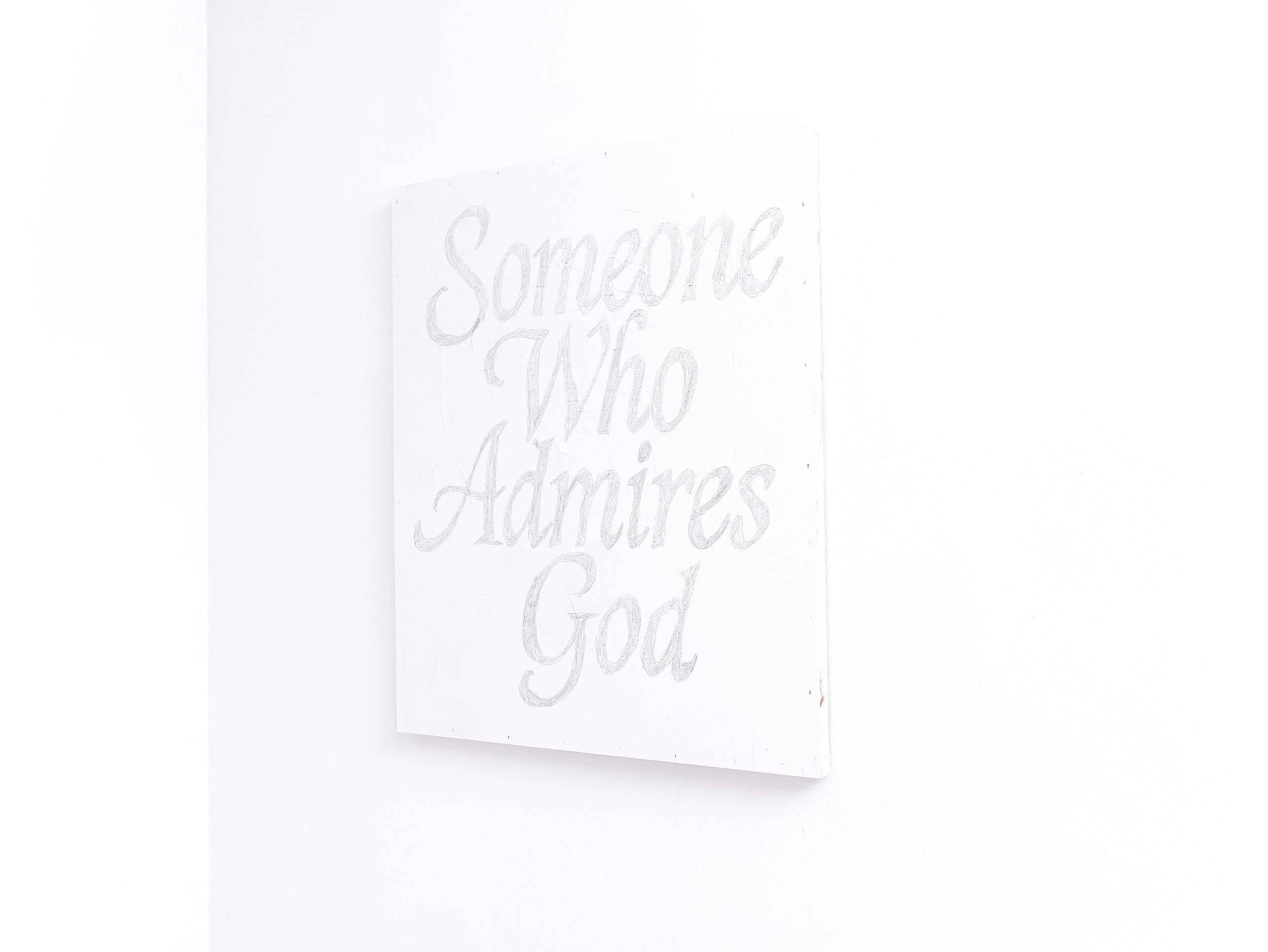
The first World Cup in Korea — the 17th FIFA World Cup (official name: 2002 FIFA World Cup Korea/Japan) — took place from May 31 to June 30, 2002, in South Korea and Japan. They were the first Asian hosts of the tournament. It was the first time that, as a child, Jeremy ever heard of Korea. During his two-week residency at Studiya Gallery, he painted on wooden panels the colors of the World Cup ball — a kind of tornado, spinning top, or flame suggesting speed. The vivid, ultra-present colors no longer reveal the shape of the ball but give way to an imaginary symbol that could resemble a new emblem of a new religion or another emerging popular community, to be spread throughout the city or within our minds. A few days later, Jeremy decided to repaint the wooden frames entirely white, leaving only a few traces of the paint’s thickness visible, like veins — scars from a past whose memories are too recent yet to be dissected. On this new surface, he drew in pencil the words “Someone Who Admires God,” which he found in an Instagram post by Young Thug, the American rapper and singer whose real name is Jeffery Lamar Williams.
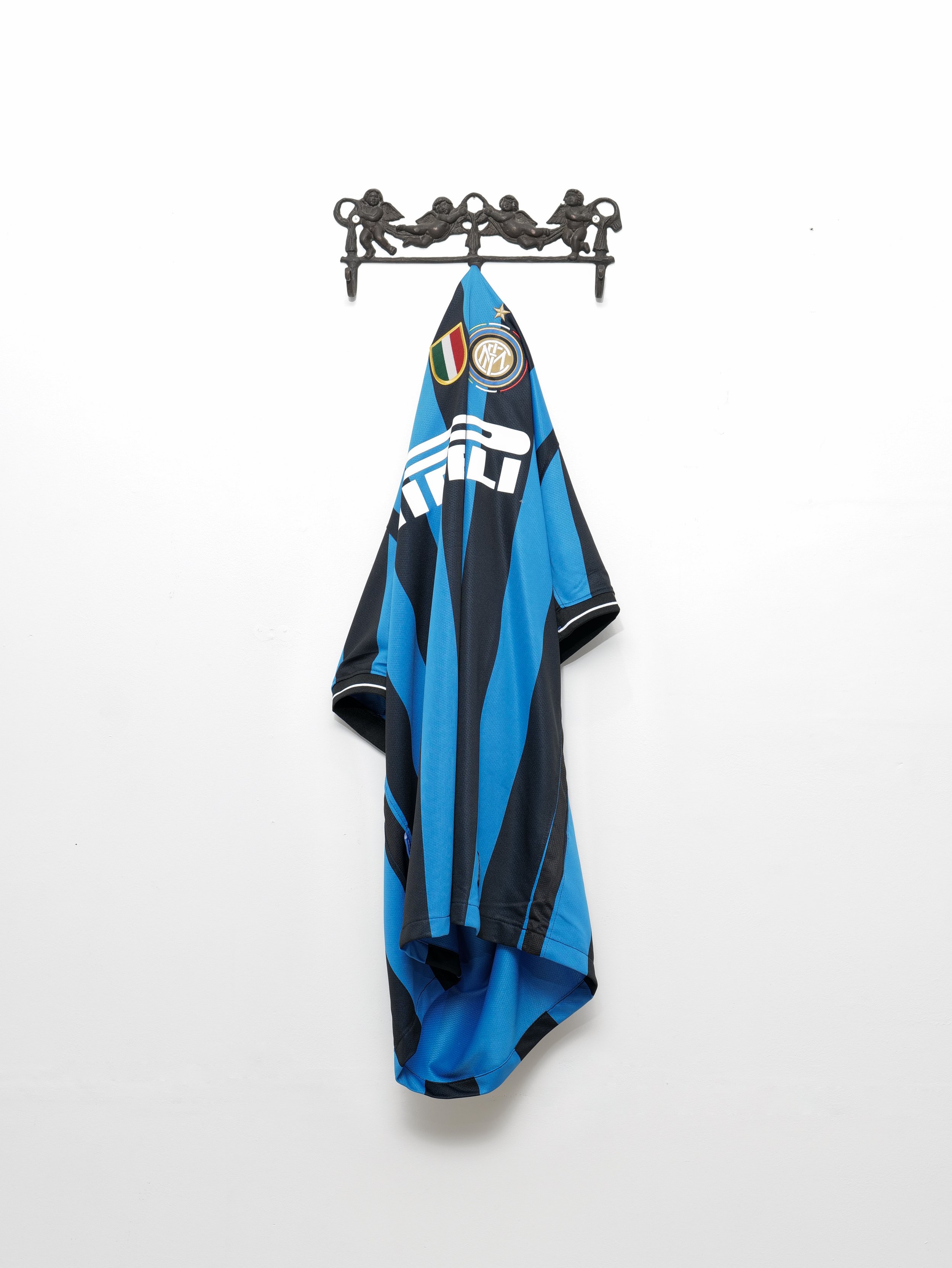
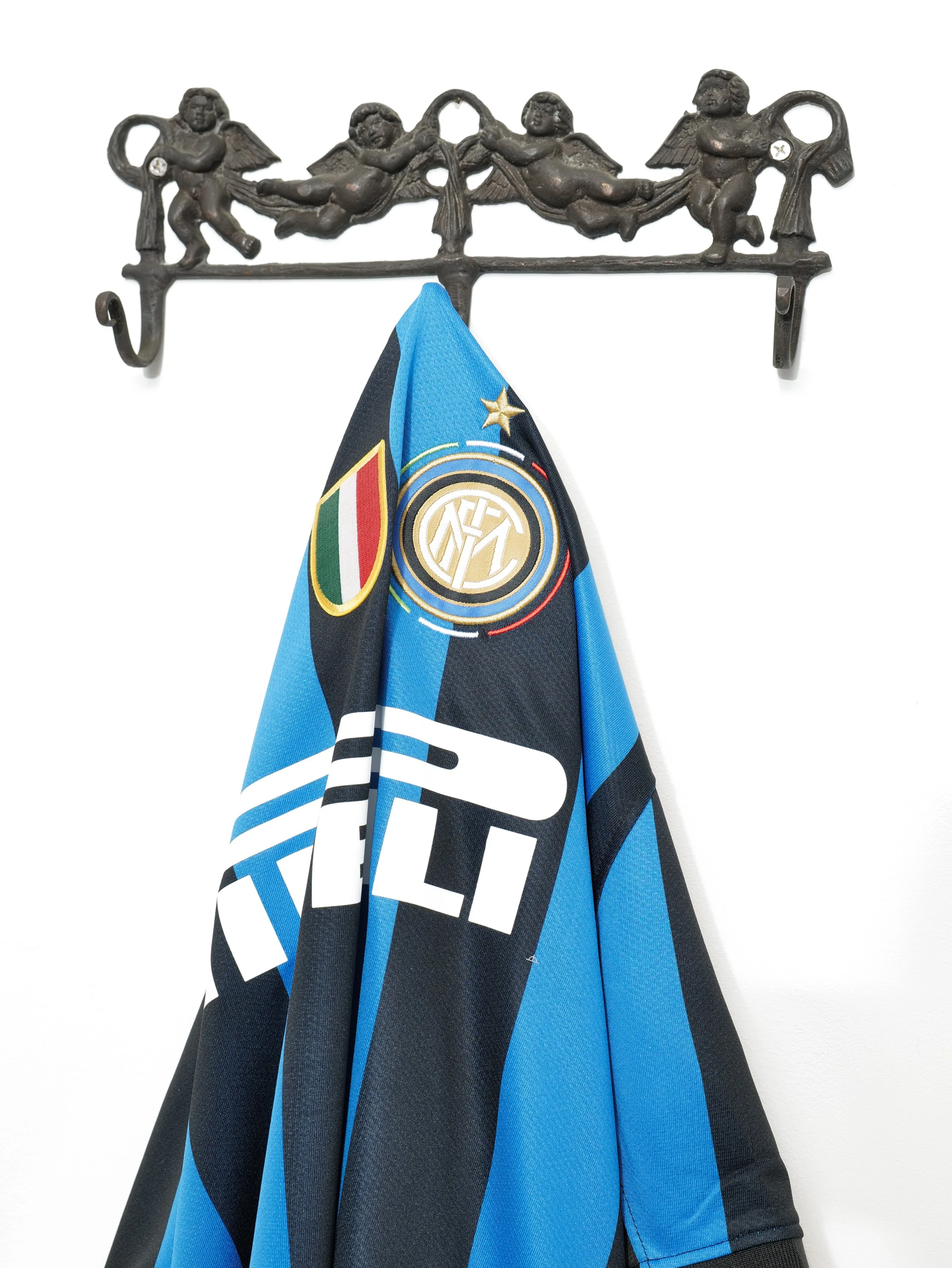
This gesture, which echoes Jeremy’s passion for popular events such as football gatherings and his devotion to hip-hop, appears again in another work: a jersey from his favorite team, Inter Milan — which he bought at a flea market in Seoul — suspended from a hook alongside representations of angels also sourced from a local hardware store. This suspension elevates the jersey to the level of an untouchable relic: the best, the essential, something attainable by others but not by the one who believes in it fully, with the faith of a supporter — the fanatic for whom football is a true religion.
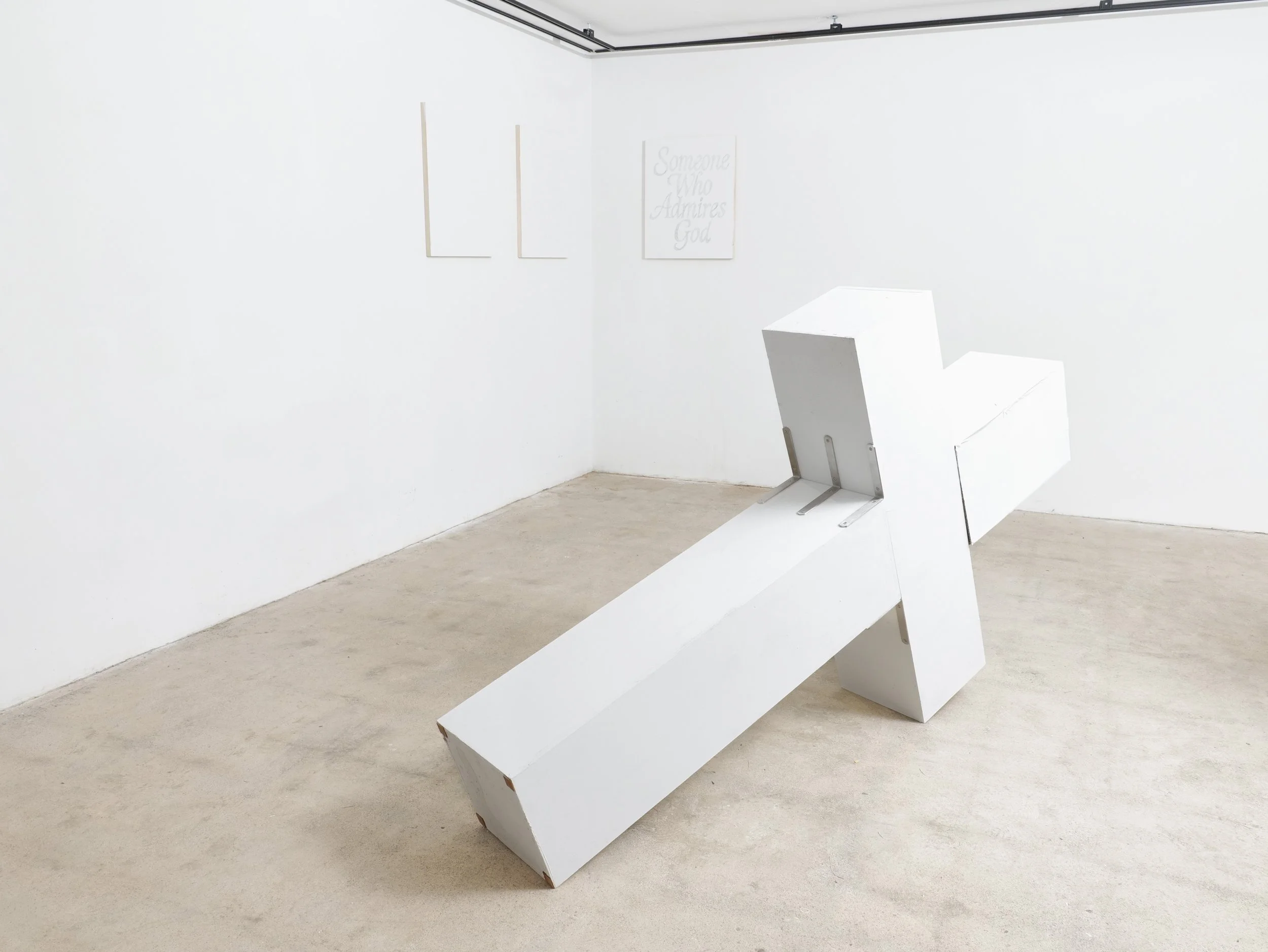
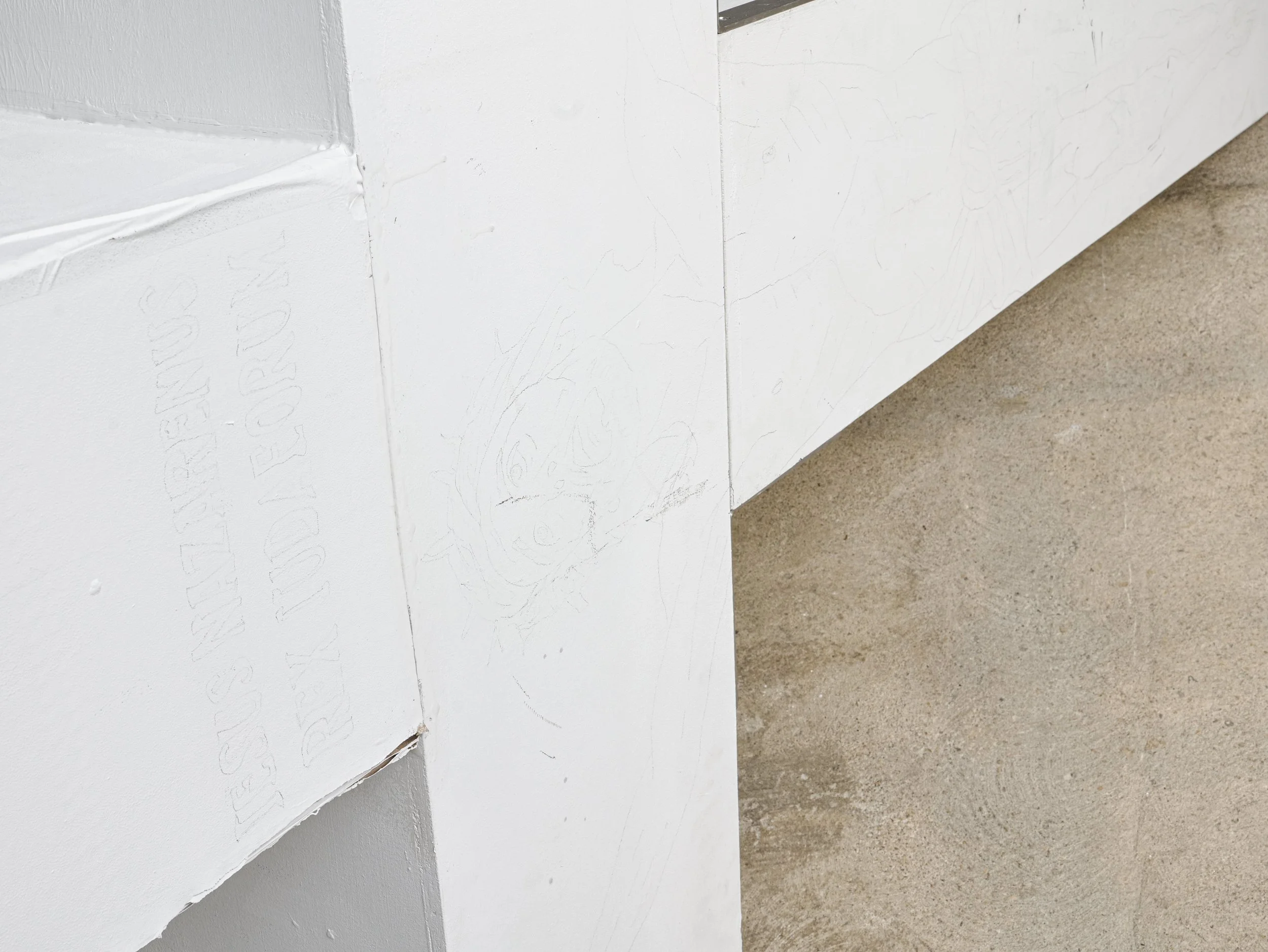
This faith in God also reappears in the major intervention of reconstructing a monumental minimal cross within the exhibition space. It blurs any belonging to a specific doctrine. Visible from the outside, its shadow welcomes us into the exhibition, inviting us to connect with the omnipresent crosses in Seoul—Catholic or Protestant—recognizable for their red neon glow, sometimes of enormous size, a kind of visual punchline. Here, doubts intertwine, helping us grasp what seems to slip away amid all these prayers to God. And what face should one give to Jesus? The one that has infiltrated our collective memory for centuries? The cross, built at the scale of the exhibition space and assembled from materials recovered from the gallery — pedestals from previous exhibitions — invites us to dive into the secrets and mysteries of our own beliefs and their survival in a space as turned inward as outward. The discussion is only just beginning, and the transition from one space to another unfolds with complete fluidity, in an upheaval of beliefs that invites us to explore multiple spiritual paths.
Marco Godinho
룩셈부르크 출신 예술가 제레미 팔루체(Jeremy Palluce)가 한국으로 돌아왔다. 2023년 부산에서 한국의 예술가 정시진(Sijin Jung)과 함께 첫 프로젝트를 진행한 데 이어, 이번에는 서울에 기반을 둔 아트 컬렉티브이자 작가들이 운영하는 공간인 스투디야(Studiya)에서 레지던시를 진행한다. 그는 문화적, 사회적, 대중적 코드를 탐구하는 연구를 확장한 전시 <NO_HOOK_POST_JETLAG>를 선보인다.
이 전시의 출발점은 라 페브(La Fève)의 곡 제목에서 차용한 “NO HOOK”이다. 라 페브는 콩고와 카메룬 혈통의 프랑스 래퍼로, 다양한 영향력과 혁신적인 접근을 통해 프랑스 랩의 ‘뉴 웨이브’를 구현한 인물이다. 음악적 맥락, 특히 랩과 힙합에서 ‘훅(hook)’은 반복적이고 중독성 있는 트랙의 일부, 주로 코러스를 가리키며 청취자의 귀를 사로잡고 기억에 남도록 설계된다. “No Hook”은 문자 그대로 “후렴구 없음”을 의미하며, 이러한 전통적인 반복구조 없이 트랙을 구성하는 접근법을 가리킨다. 이는 팝과 랩 음악의 상업적 관례에서 벗어나, 연속적인 흐름, 끊김 없는 서사, 또는 더 자유로운 형식의 탐구를 추구한다. 이는 쉽고 예측 가능한 훅을 거부하고 더 원초적이며 직접적이고 진정성 있는 것을 추구하는 예술적 제스처이다.
팔루체는 제목에 밑줄을 추가함으로써 올해 초 룩셈부르크 콘슈탈 에슈에서 열린 전시 <_FINAL_FINAL>에서 시작한 탐구를 이어간다. 해당 작품은 모든 형태가 끊임없이 새로운 수정에 노출되는 디지털 세계에서 확정적이고 고정된 ‘완성본’이란 것이 불가능함을 암시한다. POST_JETLAG, 즉 “수면 중 각성”(Awakened Sleep)을 통해 작가는 다시 한번 우리로 하여금 종교적이든 도시적이든 그 밖의 어떤 것이든 우리의 코드를 의심하게 하고, 유머를 잃지 않으면서도 끊임없이 변모하는 세계로 뛰어들도록 초대한다.
제레미가 룩셈부르크에서 직접 가져온 컴퓨터 파일 중 최초이자 유일한 요소 중 하나는 그의 친구이자 동료인 룩셈부르크 래퍼 브루즈(Brooze)의 최신 앨범에 수록된 애드립이다. 경력주의적이며 맥락적인 접근을 취한 이 최신 앨범은 독일어에 초점을 맞추고 있으며, 제레미가 최근 곡들의 애드립 공유를 요청한 한국 래퍼(영 잔디스)의 애드립과 겹쳐지는 이 파편들에서도 독일어가 들린다. 후자의 경우, 한국 래퍼가 씬에 진입하기 위해 주력하는 언어는 영어다. 같은 공간에 모인 두 세계는 마치 결투나 배틀처럼 마주보며 교차하고 서로 반응한다. 방 한가운데 바닥에 놓인 미니멀한 오브제는 첫 번째 방에 있던 다른 작품의 받침대를 연상시킨다. 이는 빛의 투사 속에 놓여 기다리며, 움직이는 관람객들의 몸을 받아들일 준비가 되어 있다. 관람객들은 움직임을 통해 음악적 언어의 창조를 마치 종교처럼 믿는 근본적인 신념을 활성화시킨다.
한국에서 열린 첫 월드컵 — 제17회 FIFA 월드컵(공식 명칭: 2002 FIFA 월드컵 한국/일본) — 은 2002년 5월31일부터 6월 30일까지 한국과 일본에서 개최되었다. 이들은 아시아 최초의 월드컵 공동 개최국이었다. 어린 시절 제레미가 한국이라는 나라를 처음 알게 된 계기이기도 했다. 스투디야에서 2주간의 레지던시 기간 동안 그는 월드컵 공의 색상을 나무 패널에 그렸다. 회오리바람, 팽이, 혹은 불꽃처럼 회전하며 속도를 암시하는 색상들. 생생하고 극도로 현실감 있는 이 색상들은 더 이상 공의 형태를 드러내지 않고, 도시 전역이나 우리 마음속에 퍼져 나갈 새로운 종교의 상징이나 또 다른 대중적 공동체의 상징처럼 보일 수 있는 상상의 상징으로 변모한다. 며칠 후 제레미는 나무 프레임을 완전히 하얗게 다시 칠하기로 결정했다. 과거의 기억이 아직 해부하기엔 너무 생생한 상처처럼, 혈관처럼 보이는 페인트 두께의 흔적만 남겼다. 이 새로운 표면에 그는 연필로 “신을 경외하는 자(Someone Who Admires God)”라는 문구를 그렸다. 이는 본명 제프리 라마 윌리엄스(Jeffery Lamar Williams)인 미국 래퍼 겸 가수 영 떠그(Young Thug)의 인스타그램 게시물에서 발견한 문구였다.
이 제스처는 제러미가 축구모임 같은 대중적 행사에 대한 열정과 힙합에 대한 헌신을 반영하며, 그의 다른 작품에서도 재현된다. 서울의 벼룩시장에서 구입한 최애 팀 인터 밀란(FC Inter Milan)의 유니폼이 현지 철물점에서 구한 천사 형상들과 함께 옷걸이에 매달려 있다. 그렇게 유니폼을 손댈 수 없는 유물 수준으로 끌어올린다. 이는 최고이자 필수적인 것, 다른 이들이 손에 넣을 수 있으나 이를 완전히 믿는 자—축구라는 진정한 종교를 가진 광신도인 서포터의 신앙을 가진 자—에게는 불가능한 것이다.
작가의 신에 대한 믿음은 전시 공간 내에 기념비적이며 미니멀한 십자가를 재구성하는 과정에서 다시금 드러난다. 이는 특정 교리의 소속감을 흐릿하게 만든다. 건물 외부에서도 보이는 그 그림자는 우리를 전시로 초대하며, 서울 곳곳에 존재하는 십자가들—가톨릭이든 개신교든—과 연결되도록 이끈다. 빨간 네온 불빛으로 알아볼 수 있는, 때로는 거대한 크기의, 일종의 시각적 결말 같은 그 십자가들 말이다. 여기서 의문들이 얽히며, 신에 대한 수많은 기도 속에서 사라져가는 듯한 것들을 붙잡게 한다. 예수의 얼굴은 어떤 모습이어야 할까? 수세기 동안 우리 집단 기억에 스며든 그 얼굴일까? 전시 공간 규모로 제작되고 갤러리에서 회수한 재료들—이전 전시의 잔해들—로 조립된 이 십자가는 우리로 하여금 자신들의 신념과 그 신념이 내면과 외면으로 동시에 열린 공간에서 어떻게 생존해왔는지에 대한 비밀과 신비 속으로 뛰어들도록 초대한다.
이 논의는 이제 막 시작되었으며, 한 공간에서 다른 공간으로의 전환은 신념의 격변 속에서 완전히 유동적으로 펼쳐지며, 우리로 하여금 다양한 영적 길을 탐구하도록 초대한다.
마르코 고디뇨